

 LinkedIn
If you are the agency founder with a DocuSign tab open, about to buy AEO software for your next client retainer, close it for ten minutes. A per-prompt contract can charge you more every time you find another buyer question worth tracking. Your client’s retainer will not rise with it.
I know why the contract is tempting. Your clients are asking why competitors appear in Google AI Overviews and ChatGPT search while their own brands do not. You need an answer you can sell as a service, not an experimental side project. You want to offer white-label AI SEO without hiring people to query chatbots all day.
But look at the clause that limits you to 50 or 100 tracked prompts before overages begin. If your team uncovers thirty more high-intent questions a client ought to win, the software bill rises while the retainer stays flat. And if the platform only reports missing citations, your team still has to write pages, handle technical changes, and get those pages published. You pay more to find the work, then pay people to do it.
The prompt cap gets tighter as your research gets better
Take another look at the pricing matrix. Otterly AI, for instance, lists an entry plan at $29 a month for 15 prompts, a $189 plan for 100 prompts, and $99 for each additional batch of 100. Coverage across Claude, Google Gemini, or Google AI Mode sits behind separate monthly add-ons. Profound lists a $99 Starter tier with 50 prompts on ChatGPT; its $399 Growth tier covers Perplexity and Google AI Overviews with a 100-prompt ceiling. Agency workspace fees add another $399 a month per client.

Fifty prompts can sound generous when you first set up an account. You track the brand name, a couple of product categories, and a few comparison queries. Then you listen to how buyers actually ask for help: they include industry context, budget limits, feature requirements, and the problem they need solved. One mid-market B2B software client can give you sixty conversational variations across five buying stages. Track only twenty and you leave much of that journey out of view.
The questions you leave out are not necessarily the least useful ones. A tidy list of category terms is easy to assemble before you understand the client’s buyers. The harder, more specific questions often arrive once you have done the research the retainer is supposed to cover. If your tool makes you choose between tracking those questions and protecting your margin, its pricing is shaping your service. That is a strange incentive to accept before you have even sold it.
That is the trap. Better research expands the list, and metered pricing turns that work into a higher recurring cost. Normalized agency cost comparisons put tracking costs between $0.82 and $3.99 per prompt each month. If you move a client from 20 surface-level prompts to 100 commercial questions, your tool bill can climb sharply. You cannot comfortably call in month three to say, “We found 80 more questions your buyers ask, so we’re raising your invoice.” Price the questions you have yet to discover, not just the ones on your list today.
What ten client domains do to the bill
Say you have ten clients paying $2,500 a month each: $25,000 in monthly retainer revenue. You plan to add AI search optimization across those accounts. The figures below are illustrative, rounded tool costs, not a forecast of any one vendor contract. They show why you need to model the service after the tracking list grows.
In month one, you might start with 25 prompts per domain on an add-on such as the Semrush AI Visibility Toolkit, at $99 a month per domain, or $990 across ten accounts. By month six, you have mapped more buyer questions and want to track 100 prompts per client across dedicated workspaces. Using Profound’s stated $399 monthly agency workspace fee per client alongside its $99 base fee puts that example at $4,089 a month. By month twelve, if you are tracking 150 prompts per client and paying for additional capacity, the illustrative diagnostic bill in this scenario reaches $5,280.
Those rows use different tool configurations; they do not describe one vendor raising its price on the same contract. That distinction matters when you compare quotes. The point is to put your likely mature tracking requirement beside the entry price before you promise clients a fixed monthly service. Otherwise, the cheapest way to preserve your margin may be to stop asking useful questions.
Now compare a flat per-domain model. groas For Agencies prices SEO and AI search execution at a flat monthly fee per client domain. Across ten domains, that is $1,990 a month at each stage:
| Stage | Prompts tracked per client | Illustrative capped-tool cost, 10 clients | groas per-domain cost, 10 clients | Difference in monthly tool cost |
|---|---|---|---|---|
| Month 1 | 25 | $990 | Flat fee | Metered can cost less early |
| Month 6 | 100 | $4,089 | Flat fee | groas fee unchanged |
| Month 12 | 150 | $5,280 | Flat fee | groas fee unchanged |
The first row matters. Flat per-domain pricing is not automatically cheaper on day one. Its value is that discovering more questions does not, by itself, raise the per-domain price. The other cost belongs in your spreadsheet too: the people who must interpret reports and turn them into live work. Our breakdown of what a ten-client AEO retainer actually costs looks at that delivery question. Before you set a retainer price, model both the mature tracking list and the labor behind it.
Do that calculation for the whole roster, not only the client whose contract is on your desk. An overage that looks manageable on one domain becomes a standing expense when the same research standard applies to ten. Your retainer has to cover the work you intend to do consistently. It cannot depend on your team keeping every client’s question list conveniently short.
A dashboard still leaves you with the job
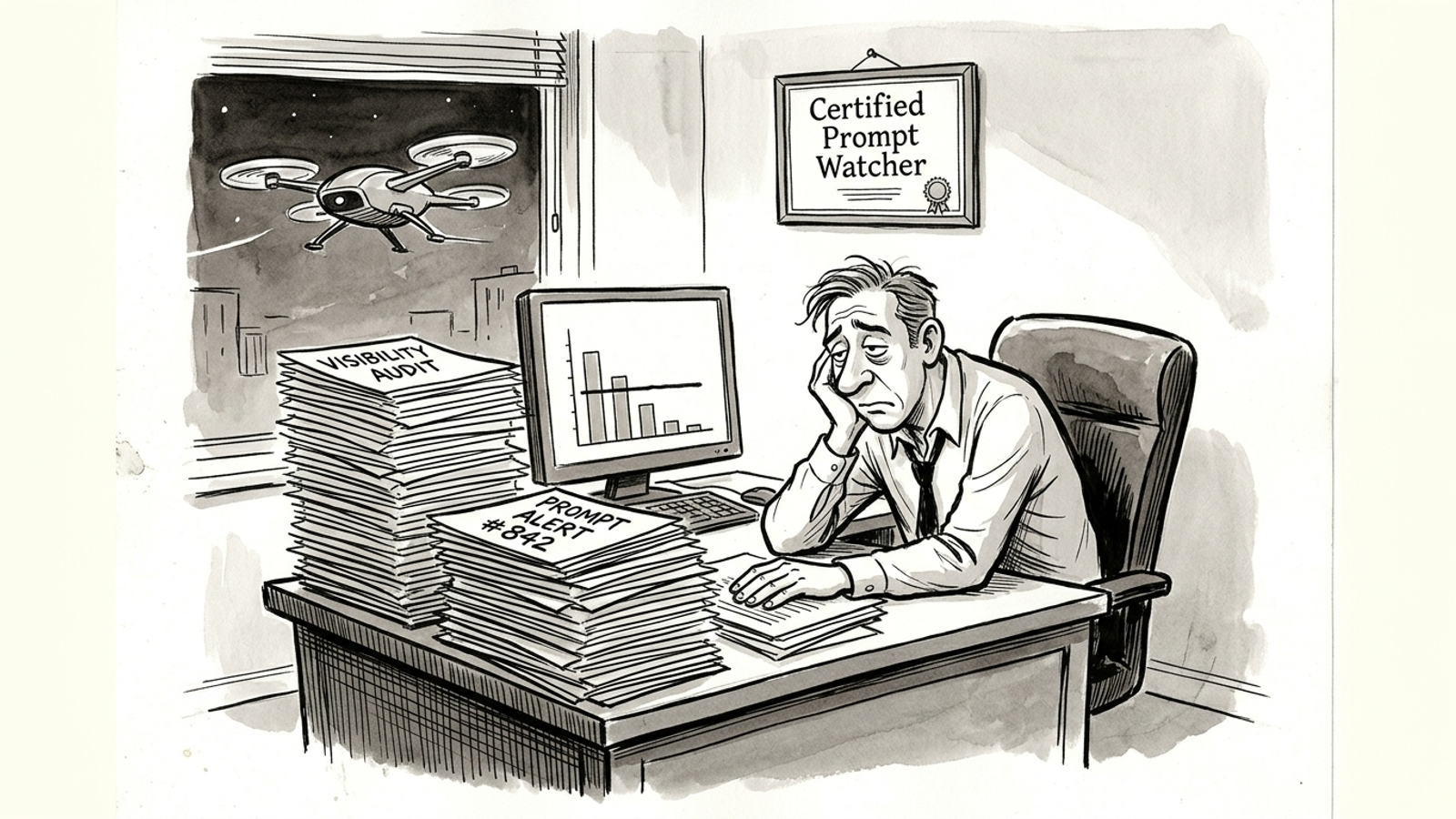
Around week six, you may discover you did not buy an execution system. You bought a telescope. Peec AI describes its platform as having “no content generation”; its tiers run from €85 to €499+ a month for tracking prompt runs across multiple models. A monitoring platform can tell you that Perplexity cites a competitor’s comparison page instead of yours. It can show a visibility score moving the wrong way. Then your team has to decide what to change and make it happen.

That distance between a finding and a published change is the briefing-to-publish gap. Your client does not pay a retainer for a screenshot of ChatGPT recommending a competitor. Your team has to research the page that could answer the buyer’s question, write it, structure any relevant JSON-LD, check crawler access against the client’s policy, and publish updates in Webflow, WordPress, or Shopify. A report may tell you where to start. It does not complete that list.
Nor does a longer list of alerts solve the problem. It gives your team more findings to sort while the client waits for something to change. When you compare platforms, trace one finding all the way to a published update. Note each handoff your staff must make. That is the workflow you are buying, whether the sales demo spends time on it or not.
With an analysis-only tool, you still need people to translate alerts into tickets, draft content, and make technical changes. Those hours come out of the same retainer as the software fee. groas takes a different approach: specialized AI models draft content, deploy technical fixes, and manage citation signals continuously, while a named senior strategist oversees the account within client guardrails under your agency’s white-label branding. Ask whether the tool changes the client’s site or merely changes your team’s to-do list.
I have seen this billing pattern before
I spent years managing search accounts the slow way: building match-type structures by hand, pulling negative search terms at 1 a.m., and exporting CSVs into pivot tables so I could show a client twenty pages of charts that mostly said the budget had been spent. I respect the judgment good account work takes. I do not miss charging human hours for every repetitive step around it.
As bid management became more automated and match-type work changed, that distinction mattered more. An agency could keep billing for the old routine, or it could put its time into decisions the client actually needed made. I see the same choice in AEO. You can rebrand a diagnostic report as “custom AI search intelligence,” but your client will still want to know what changed on their domain. Sell the work that closes the gap, not the act of reading the alert.
Five questions for the vendor on your screen
Before you sign an annual contract or move into an enterprise tier, ask the sales rep these questions. Get answers for the ten-client roster you intend to run, not only the first domain you plan to connect.
- What happens to our bill when we add 50 buyer prompts for a client? Ask about prompt, keyword, query-run, and model-specific limits. A low entry price tells you little if thorough research moves every account into another tier.
- Does the platform make changes or recommend them? If your staff must still write pages, prepare schema, check technical access, and publish, put those hours beside the subscription cost.
- What does a white-label client workspace cost? Ask whether branded reporting and each additional domain are included, or whether seats and workspaces carry separate monthly fees.
- How does it connect to client sites? Find out what your team must do before an approved change can go live. Onboarding effort is part of delivery cost, even when it is absent from the pricing page.
- Can we test it on a live domain before committing? You need to see the platform’s actual workflow, not just an interface tour.
If you want the wider roster comparison, see The Best AEO Software for Agencies at Client Number Ten. For this contract, make the vendor show you the cost of account number ten.
What to get in writing
The sales conversation is not the agreement. Before you sign, make these four terms explicit:
- How prompt limits and overages work per domain. Your invoice should not surprise you because your team found forty more commercial questions. If there is a cap, model the price beyond it.
- What the platform actually executes. Content generation, structured data, and technical changes are different from an alert feed. Price a monitoring tool as monitoring, with the human work listed separately.
- What white-label delivery includes. Check the cost of client workspaces, branded reports, and additional domains before you build a retainer around the entry tier.
- Whether you can run a live trial and cancel month to month. Test the workflow on a real client account before committing to a longer agreement.
This is why groas For Agencies uses flat per-domain pricing rather than metered prompt counters: SEO and AI search execution is a flat monthly fee per client domain, with no setup fee, month-to-month terms, and a seven-day live trial on a real client account before you pay. Specialized models handle content and technical work continuously; a named senior strategist supervises the account under your agency’s brand. You still own the client relationship and the direction of the work. Your staff does not have to turn every new dashboard alert into another manual project ticket.
Close that contract tab. If the vendor cannot tell you what happens to your price when you do more research, or who does the work after its dashboard finds a problem, do not sign yet.
Sincerely,
Someone who used to bill by the hour.